

Caravan Water Filters Australia — How to Choose the Right System for Your Trip
February 27, 2026 12:17 pm Leave your thoughts
Australians love travelling and exploring the great outdoors. Caravans and RV’s give us the freedom to adventure around our great nation and to see new locations and meet like-minded people.
However, accessing high quality safe drinking water while on the road can be challenging.
When travelling in remote locations such as the outback, quite often the only water source available may be tank, bore or river water. These water sources are likely to be high in sediment and contain contaminants such as giardia, cryptosporidium, heavy metals, chemicals, scale and cysts parasites.
If you are travelling through major cities or regional areas, the water is likely to be heavily chlorinated or contain water softening chemicals, which many people prefer to remove.
Don’t fret! We have a water filtration solution for each of these areas.
These solutions will either completely eliminate or dramatically reduce most types of contaminants, leaving you with water that is clean, safe, and tastes delicious.
In this guide we will explain why water needs to be filtered and offer a short guide on choosing the right water filter system for your caravan.
If you simply want to know which type of filter to choose, jump ahead to the section on Choosing The Right Water Filter For Your Caravan or contact Clarence Water Filters by giving us a call on 02 6646 8565. You can also email us at sales@clarencewaterfilters.com.au.
Table Of Contents
Why Do We Need A Water Filter On Our Caravan or RV?
How Do Caravan Water Filters Remove Common Contaminants?
Common Types Of Water Filtration Media
The Importance Of Having a CYST Rated Water Filter
How Filtration Affects Water Flow Rates
Types of Caravan Filtration Systems
Choosing The Right Water Filter For Your Caravan
Simple Caravan and Motorhome Water Filter Finder
Why Do We Need A Water Filter On Our Caravan or RV?
Most parts of Australia have access to clean drinking water.
However, when you are traveling you will come across a wide range of water sources that will be very different to what you and your body are used to.
The water you encounter may have much higher levels of contaminants than your normal water, including:
Chlorine and Chloramines
Virtually all towns and cities in Australia will add chlorine to their water supplies to kill protozoa, bacteria, and other pathogens. However, the amounts will vary from town to town.
Whilst chlorine does a great job of killing the contaminants that cause cholera, dysentery and other conditions, it can also make your water smell and taste terrible, or make your skin and hair dry.
Monochloramine (usually called chloramine), is a chemical compound created when chlorine combines with ammonia.
Chloramines are long-lasting and can travel much further in water pipes. They are primarily responsible for the unpleasant smell of chlorinated water.
Cyst Parasites (Cryptosporidium and Giaria)
Untreated water such as tank, river or bore water can contain a wide variety of contaminants such as waterborne cyst parasites like Giardia, Cryptosporidium.
These are harmful protozoan parasites and forms of bacteria which can serious illness if ingested. Water filters with an absolute pore size of 1 micron or lower will remove most cyst parasites.
Bacteria
Untreated water from dams, waterways, tanks, and bores can also host a wide range of different bacteria including Escherichia coli (e-coli) and Coliform. These types of bacteria can make you severely ill if ingested.
Bacteria are microscopic and much smaller than Cyst Parasites or Protozoa. As a result, you will need to use a special form of water treatment to successfully remove them. Common options include UV Sterilisation, Ceramic Filtration, and Disinfection which we will dive into later.
Heavy Metals
Heavy metals like lead, arsenic, copper, cadmium, and mercury can be extremely hazardous to your health.
You are more likely to encounter these dangerous contaminants in parts of Australia with very old pipework and locations with aquifers contaminated by mining or agricultural activity.
Drinking water that contains these metals can cause immune system dysfunction, nervous system damage, kidney disease, and rheumatoid arthritis.
Rust
If you are in the outback and are forced to fill your tank up with tank water or you are using old water infrastructure, your water may be contaminated with rust.
Although low levels of rust won’t affect your health, your water will taste and look terrible. It can also stain clothing and cause damage to the water pipes or appliances in your caravan.
Fluoride
Most locations in Australia will add fluoride to the water supply to prevent dental disease. However, there is some debate about the safety of consuming fluoride over a long period.
Although it is difficult to remove all fluoride from water, there are several types of water filters which can remove most of it.
Sediment
Water tanks, bore water, and old pipes can contain a large amount of sediment which can negatively affect the smell and taste of your drinking water. In severe cases, sediment can cause blockages or corrosion of metal fittings.
Hard Water and Water that is High in Minerals
Some locations within Australia have ‘hard’ water, which is water with a high level of dissolved minerals which most people find unpleasant.
Running hard water through your caravan can cause scale to form on the inside of pipes, fixtures, coffee machines, hot water heaters and other appliances. This can eventually cause damage to your caravan’s pipework or cause appliances to break down.
Chemicals and Pesticides
There are a variety of dangerous chemicals and pesticides which make their way into the water supply and can pose a health risk for humans. They include:
- Trihalomethanes (THMs)
Trihalomethanes are a group of chemical compounds that can form when chlorine reacts with rotting organic matter like sewage, dead vegetation, farm runoff, and dead animals. Researchers believe that THMs may be carcinogenic. - Poly and Perfluoroalkyl Substances (PFAs)
PFAs are a class of over 4,000 different chemicals. These chemicals are used in everything from plastic products to firefighting foams and water repellents. Unfortunately, some PFAs have been found to be toxic to humans and can increase of serious diseases like cancer. - Volatile Organic Compounds (VOCs)
VOCs are carbon-based chemicals that evaporate at room temperature. Many common household products contain VOCs including cleaning products and paint. The most common VOCs include acetone, formaldehyde, benzene, ethylene glycol, perchloroethylene, xylene and toluene. They can cause a variety of health issues including eye, nose and throat irritation, headaches, fatigue, shortness of breath, dizziness, nausea, and skin problems. Long term exposure can cause damage to the liver, central nervous system, kidneys, and other organs. - Nitrate/nitrite
Sewerage and fertiliser runoff can both contaminate groundwater supplies with nitrate. Although nitrate is harmless, it can convert into nitrite, which is capable of causing health problems in children and young babies.

How Do Caravan Water Filters Remove This Material?
Caravan water filters can use a variety of methods to remove contaminants from water. However, the most commonly used filters use one or more of the following methods:
1. Mechanical Filtration
The idea behind mechanical filtration is simple. The filter physically acts like a sieve which removes sediment, dirt, metals, and other particles which are large than the holes in the filter material.
Mechanical filters can be made from many different materials. However, the most commonly used options are spun bonded polypropylene (also called polyspun) and pleated filters (polyester). They are both fantastic options for removing dirt, algae, rust, and larger particles
2. Absorption Filtration
Absorption water filters are made from materials capable of trapping water-borne contaminants. They are particularly useful for removing chemicals like chlorine, which is added to the water supply by most councils in Australia.
Activated carbon is the most frequently used material in absorption filters. It is typically made from crushed coconut shells or coal which has been ‘activated’ to increase the surface area available for adsorption or chemical reactions.
Activated carbon has a matrix of carbon particles with many microscopic pores and pits. As the water flows through the filter, chlorine, sediment, and volatile organic compounds (VOCs) are trapped (absorbed) by these pores.
Eventually, the absorption filter will become clogged with impurities and need to be replaced or emptied
3. Sequestration Filtration
Sequestration involves the use of a chemical to isolate a specific substance. The most common example of sequestration filtration in world of caravanning is polyphosphate.
It is a food grade non-toxic chemical which can sequester calcium and magnesium in water. This makes it more difficult for these minerals to cause limescale and corrosion in your caravan’s plumbing and appliances.
4. Ion Exchange
Ion exchange filtration typically involves the use of a hydrogen based ion exchange resin, which physically removes certain elements. It is often used to remove minerals like calcium and magnesium from hard water.
Some water softener filters will use sodium ions which can to be ‘recharged’ intermittently by back flushing the media with salt water. However, other resin filters are seal units and are simply replaced once they become ineffective. Back to top
Common Types Of Water Filtration Media

The most frequently used water filtration media in caravan filters include:
Activated Carbon
Activated carbon is capable of absorbing chlorine, volatile organic compounds and sediment from water. It is a great choice for eliminating the taste and odour of chlorine from water.
Activated carbon is available in granular form, called Granular Activated Carbon (GAC) and in carbon blocks. It is called ‘activated’ carbon as it is treated to increase the number of pores, which improves its absorption capacity.
Carbon blocks are more compressed so can deliver a finer level of filtration. However, as they are more compressed, it can limit the amount of waterflow that is available. This means GAC is used whenever high flow rate is required (for showers and so on).
Carbon filters that are rated at 1 micron or less are capable of reducing parasitic cysts, including cryptosporidium and giardia. You will require a filter rated 1 micron or less on your drinking water if you ever fill up with unchlorinated water from water tanks or bores.
Catalytic Carbon
Catalytic carbon is carbon that has been chemically modified to alter the ionic structure of the carbon. This improves its catalytic capability, making it easier for the carbon to absorb chemicals. It is more effective that activated carbon, particularly when it comes to absorbing chloramines. However, it is also more expensive than activated carbon.
Kinetic Degradation Fluxion (KDF)
Kinetic Degradation Fluxion (KDF) uses electrochemical oxidation-reduction (also known as the redox potential) to remove contaminants from water. In easier-to-understand terms, KDF media will exchange electrons with contaminants, transforming them into harmless components.
The most commonly used form of KDF is KDF 55, which contains copper and zinc. Because copper has a negative charge, it will attract contaminants that have a positive charge. Zinc, meanwhile has a positive charge, which will attract contaminants with ah negative charge.
KDF55 can remove up to 99% of water-soluble lead, mercury, nickel, chromium, and other dissolved metals. It also reduces scale build up, bacteria and algae, even in hot water. Removes “free” chlorine, chlorinated hydrocarbons and hydrogen sulfide.
KDF 85 is designed specifically for reducing iron and hydrogen sulfide in water. It can also reduce scale, bacteria , algae, chlorine, chloramines, and heavy metals — even in hot water.
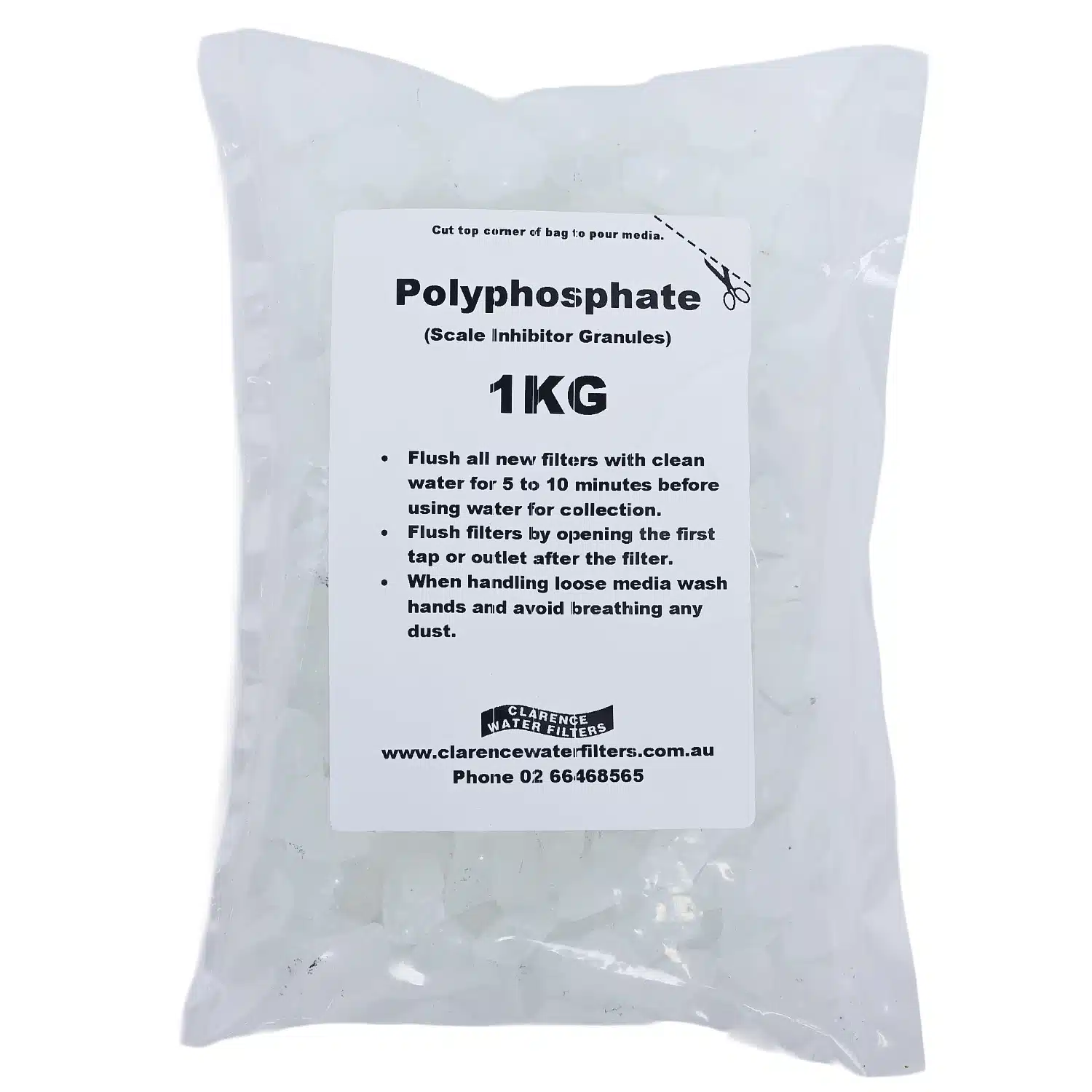
Polyphosphate
Polyphosphate is a food grade additive which makes it harder for the minerals in hard water to form scale. Using polyphosphate is a great idea for when you are traveling to South Australia, the Northern Territory, outback Queensland, Western Australia or any other location with hard water.
It’s important to note that polyphosphate inhibits scale production and does not eradicate it completely. The minerals are still present in the water but are less likely to create hard scale on your pipes and appliances.
Silver
Some caravan water filters will use silver impregnated carbon. It helps to prevent bacteria building up inside your filter when it isn’t being used. This is particularly handy for caravanners who only take their caravan out on the road intermittently. Back to top
The Importance Of Having a CYST Rated Water Filter
Water obtained from lakes, streams, groundwater, and other untreated sources can contain protozoa, bacteria and viral contaminants.
This can include cyst parasites like Cryptosporidium parvum, Giardia lamblia, and Cyclosporiasis. They are single cell parasites commonly found within the intestinal tract of humans and animals.
If a human consumes water contaminated by cyst parasites, they may become ill experiencing diarrhoea, fatigue and weakness, nausea, vomiting, loss of appetite, abdominal pain, and headaches.
If you travel off the beaten track and sometimes use water which is unchlorinated or has been sitting in a tank for a long time, you need to protect yourself from these types of contaminants.
The simplest way to do so is by using a ‘CYST rated’ carbon filter on your drinking water. These filters have an absolute pore size of 1 micron or less which blocks most cyst parasites as they are between 2 to 4 microns in size. Back to top
How Filtration Affects Water Flow Rates

It’s important to understand that using very fine filters can reduce your flow rates. For example, if you installed a 1 micron carbon block filter on your main water line, you might reduce the flow rate and possibly increase the need to replace the filters on a more regular basis if there is sediment in the water supply.
While this flow rate would be fine for filling a glass of water, it wouldn’t be suitable for a shower. Using a 5 micron carbon block or 5 micron granular activated carbon (GAC) with KFD55 media would let you achieve a faster flow rate, but it would not be capable of filtering cyst parasites.
Many caravanners will use two water filtration systems to overcome this limitation. They might have a high flow inline or filter housing system to filter water which is used for showers, washing machines, and toilets and filling water tanks. An additional 1 micron cyst rated filter maybe used on the caravan’s drinking water.
The flow rate reduction that occurs when using a 1 micron filter isn’t significant on town mains pressure but when using your 12v pump it can reduce dramatically, but if it is only used to fill up drinking glasses, pots, and jugs this should not be a problem. Back to top
Types of Caravan Filtration Systems
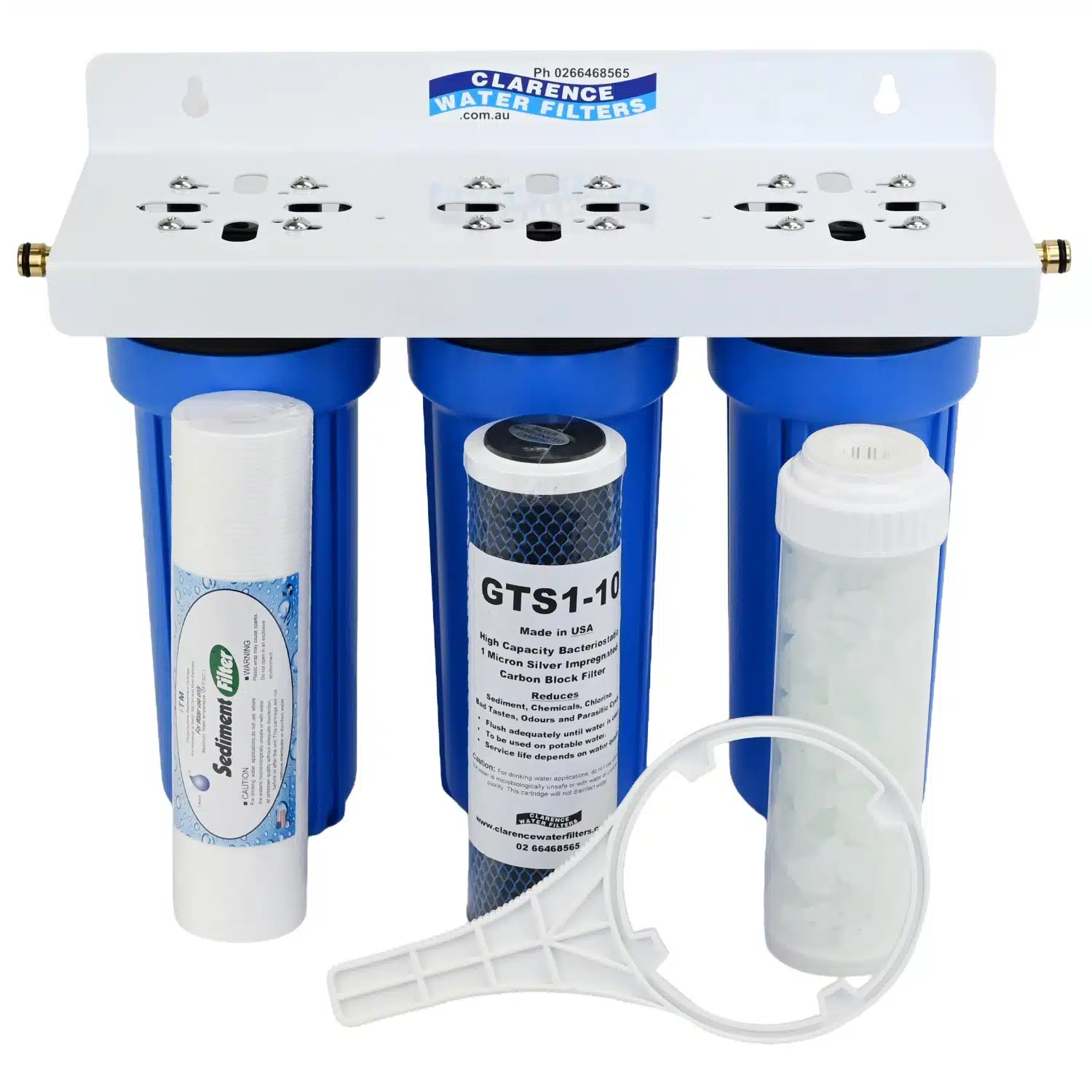
There are several types of filtration systems available for caravans. The most common options include:
External systems (inline and portable filter systems)
The simplest and most affordable option.
It is very important to use a food grade drinking water hose to supply any water that you will be using to reduce the chance of water being contaminated or that garden hose taste.
External water filtration systems are useful for filtering your water before it reaches your caravan’s water tank. Filtering your water at this early stage will reduce the amount of sediment, rust, and other contaminants reaching the tank.
By reducing these contaminants, you can prevent sludge building up in your caravan’s plumbing, which protects your caravan’s pumps, valves, and appliances from damage.
External filtration can be achieved by having an external inline water filter which is attached to the hose supplying the water directly to the van or motorhome while in caravan parks.
There are several filters which can be used to for this task, including the popular AIC-K POH High Flow In Line Water Filter with GAC/KDF or the BestHF In-line High Capacity Filter. Just choose the option with click on hose fittings.
An external canister system can also be used. A variety of filter types can be screwed into the canisters to remove sediment, chlorine, chloramines, bacteria, algae, heavy metals, minerals, and other contaminants.
Most travellers will keep this canister system inside their caravans and set it up whenever they decide to fill up. Housing systems can also use click on hose fittings, which makes filtering your water simple.
Some people mount the filters on the outside of the van and run a short piece of hose from the filter outlet to the inlet of the van.
Unfortunately, This can lead to damaged filters from stones when travelling, but most are used as portable ones that can be simply put on the ground behind the inside of your van wheels so they are out of sight and the heat from the sun. Being portable also allows you to fill your tanks externally.
It’s important to note that filtered water which has been sitting in a water tanks that have not been used for a while can grow algae, especially in warm temperatures or if in storage for a while. That’s why most caravaners will drain and flush their water tanks or use anti-bacterial additives in their tanks before using.
This is why most modern vans have fitted filter system inside as a final filtration stage. Best to filter your drinking water again using a carbon or ceramic filter rated at 1 micron or less. This will ensure CYST parasites like cryptosporidium and giardia are significantly reduced or eliminated from your drinking water.
How To Maintain Your Tank
Cleaning and maintaining your Caravan or RV’s water tank is important. There are several measures you can take to ensure your water tank remains clean and safe. These include regularly draining and flushing, sanitising and cleaning, using bacteriostatic filters and correct hoses.
Regular draining and flushing of your tanks is recommended every 1-3 months if in regular use, an prior to each trip if your van has been in storage. This is best done with fresh clean water or a cleaning solution such as white vinegar or hydrogen peroxide. If using a cleaning solution be sure to flush with clean water before refilling your tank
Bacteriostatic Filters such as silver impregnated carbon blocks or filters containing KDF will naturally inhibit the growth of bacteria within the filter itself. This will aid in keeping your tanks fresher for longer.
Between travel is the most likely time for algal blooms to form in your water tank. When storing your van for more than a few weeks it is recommended that the tank be fully drained. However, even clean, empty tanks can develop algae which is why it is still recommended that your tank be cleaned and flushed before each trip.
The hose you use to fill the tank is often overlooked. Contamination often starts with the hose itself, particularly if you aren’t using an external filtration system. We recommend using a food grade hose that is capped when stored rather than your standard garden hose to reduce the risk of introducing contaminants.
Under Sink Filters
An under sink filter is one of the most convenient options for filtering water in a caravan. It is installed as part of your incoming cold water supply line to the kitchen sink, so 100% of the water that passes through the line is filtered.
The incoming water supply is attached to the inlet of the filter and the line that goes to the tap is attached to the outlet. Inline filters are available with a wide range of attachments including 12 mm quick connect high pressure tube adapters which are very popular in most caravans and motorhomes.
A separate dedicated filtered drinking water tap will allow you to use a range of different water filters. By having a separate filter tap your filters will last longer as well.
One of the most popular under bench inline filter packages we sell is the Complete Caravan or RV Under Sink Water Filter Kit.
This compact system has a filter head that is attached to the cabinetry of your caravan’s cupboard. There are two water connections on the head, one for your incoming water supply and one up to your filter tap. These water filters are very easy to change as they screw into the head like a light bulb.
A wide variety of filter types can be inserted into the head, so you can adjust the level of filtration you used based on where you are traveling and the quality of water you can access.
Once your filter is past its suggested replacement date or it is no longer filtering effectively, you simply turn off your water supply, unscrew/un-click the filter and insert a new one.
Under Sink filter housing systems
When using under bench housing system, your filters are placed inside into plastic housing sumps then screwed up onto the housing head. This type of system is bulkier, because the housings can take up more room than a small inline filter or quick change filter that screws into a small external head.
However, there are some excellent advantages associated with using housing systems. For one, it is easy to replace your filters. You simply unscrew the housing and insert a new filter cartridge. There are no clips or tubes to move.
You can also have multi-stage filtration, with two, or three housings gives you more filter options and also allows you to choose to use certain filters in different areas around Australia. This makes it possible to have a sediment filter in stage one, followed by one or two filters which reduce chlorine, heavy metals, pesticides, volatile organic compounds, scale, and other contaminants.
Filter housings tend to be larger than inline filters, which means the water can be in contact with the filtration medium for a longer period. This can improve the level of filtration you can achieve in terms of chlorine and certain other chemicals.
Bench top water filters
Benchtop water filters are filter housings that sit on top of your kitchen bench. They have a tube that connects to your kitchen’s tap along with an outlet which delivers clean, filtered water.
They work the same way as an under bench system, so you simply unscrew each housing and insert your choice of water filter. Bench top water filters are also available in single, double or triple configurations.
This type of water filter system is simple to install, reliable, and affordable. However, they are not as popular with caravanners, as they take up valuable space on the kitchen benchtop. A standard tap spout is required to allow you to connect the filter diverter.
UV Sterilizers
Ultraviolet Sterilization Systems use powerful beams of ultraviolet light to destroy over 99% of pathogens that can be found in untreated water. This includes protozoa, viruses, bacteria, cryptosporidium, cyclospora, e. coli and algal spores.
A UV sterilizer is your ultimate defence when travelling to locations with untreated water sources such a rain tanks, bores, lakes, dams and rivers. Water that has been treated with UV sterilization is safe to consume, giving travellers peace of mind no matter where their travels take them.
There are a number of UV systems available including the LED UV Sterilizers, SLT12 and the Twin Under Sink Water Filter System with LED UV Sterilizer.
It is important to understand the pre filtration is required for UV Sterilization to be effective. Sediment filtration that is rated to at least 5 micron is integral for ensuring that your UV steriliser is effective and carbon filtration is recommended. Without this pre filtration pathogens can hide behind larger particulates to avoid the ultraviolet beams making the UV sterilizer ineffective.
Pre filtration can be achieved by most of the external or point of use systems above or if space allows you may choose to go with an all-in-one solution like the Twin Under Sink Water Filter System with LED UV Sterilizer.

Choosing The Right Water Filter For Your Caravan
So, which water filter system should you get? Here is a simple guide for choosing a system which matches your requirements.
1. Evaluate your water needs
The following table will help you identify the types of media you will need to include in your filtration system to achieve specific goals. You may find that you need more than one filter to achieve your desired goal.
Are you concerned about chlorine taste and smell?
Include a filter that contains activated carbon, or GAC/KDF. It will dramatically reduce the taste and smell of chlorine.
Catalytic carbon and KDF are particularly effective at reducing hydrogen sulphur (rotten egg) smell from water.
Are you concerned about scale build-up?
IIf you travel in areas with hard water (WA, NT, SA, inland parts of NSW and QLD) you may notice a build-up of scale in your caravan. It can damage or discolour your pipes, tiles, taps, basins, and appliances.
To reduce scale build up, your filter will need to include KDF 55 or polyphosphate.
Are you worried about the presence of CYST parasites in your water?
If you sometimes fill up with unchlorinated water from a stream, river, lake, bore or tank, you have a higher risk of encountering water that is contaminated with CYST parasites like Giardia, Cryptosporidium or Cyclosporiasis.
To protect yourself against these contaminants, you will need a carbon filter with a rating of 1 micron or lower, and ideally be Silver impregnated to inhibit growth within the filter itself.
For the best protection against 99.99% of pathogens we would suggest a UV sterilization system.
Are you concerned about fluoride?
Councils often add fluoride to their water supply to improve the dental health of local residents. However, many people are concerned about the long-term impact of fluoride on their health.
There are several filters which reduce fluoride levels including the inline Omnipure K5566 inline filter. or a range of standard size cartridges for housings.
Are you concerned about heavy metal contamination?
When you travel around Australia, you may fill up your tanks with water that contains unsafe levels of heavy metals. This can be caused by groundwater contamination or the use of outdated water infrastructure.
A filter that contains heavy metal reduction activated carbon and/or KDF will do a great job at reducing the level of heavy metals in your water.
Do you need high flow filtration for a shower?
If you need a high flow rate for a shower, a system that uses granular activated carbon filter and KDF could be useful. This combination is very effective at filtering water without significantly slowing water flow rates, or use a dedicated shower filter.
Do you have other unusual problems affecting your water?
If you have discoloured, smelly, or acidic water, you may need an additional filter. Give us a call to discuss your options.

2. Choose your filtration system’s design
Next, you should decide which type of filtration system is suitable for your needs.
If you only need to filter for chlorine and CYST parasites, a single canister, inline, or benchtop filter may be all you need. This is the path many Aussie caravaners take.
They will simply buy an AIC-K 5 micron filter with click on hose fittings to filter their water before filling their tank. Alternately, they might use a single cannister with a 1 micron GTS1-10 type filter or 1 micron BestWF filter for finer filtration.
However, if you need to filter for scale, fluoride, as well as CYST parasites, you may need a multi-stage system with several canister or inline filters.
Because space is tight in caravans, you may find that your options are somewhat restricted. You may find that there isn’t enough space for a large under-bench system or a benchtop system.
If you have limited space available, you have several options available including:
- Filtering water thoroughly as it enters your caravan using an inline filter with push on hose fittings or an external filter housing system
- Using an ultra compact 1 micron inline water filter like the BESTWF or Omnipure L Series for under sink drinking water system
- Using a benchtop water filter if you have a standard tap spout available
As mentioned earlier, many caravaners filter their water twice to reduce the risk of contaminated water entering their caravan and to keep their water tanks clean.
They will use a filter that attaches to a hose to reduce sediment, chlorine and other contaminants as they fill up the tank. A separate finer filtration system under the sink can be used for drinking water to filter out CYST parasites and other contaminants.
It’s also important to consider the amount of space available on your kitchen’s benchtop. Some water filter systems involve the use of a second cold water tap for dispensing filtered water. This approach can increase the lifespan of your water filter as you will only be using it for water you are consuming.
However, if you have limited room available you might need to use a single tap for filtered water. In this scenario, you would either filter 100% of the cold water going to the tap or upgrade your tap to a three way tap like the Puretec T2.
If you have more room inside your caravan, you could use a single, double, or triple under bench system. You would also have the option of a UV system or compact reverse osmosis system. It’s really a matter of balancing your water requirements with the available space and your budget. Back to top
Water Quality By Region: What To Expect Around Australia
Water quality can vary from state-to-state and region-to-region. Use the below table to help choose the right filter for your type of travel. Keep in mind that this is a general guide. For more detailed information on what might be right for you talk to our friendly team.
| Region | Water Characteristics | Key Concerns | Recommended Filtration |
| Major Cities and towns | Chlorinated mains water | Chlorine, chloramines, heavy metals, trihalomethanes, PFA’s, taste and odour |
Sediment |
| Coastal Caravan Parks | Generally good quality mains water | Chlorine, chloramines, heavy metals, trihalomethanes, PFA’s, bad taste and odour |
Sediment |
|
WA and NT Inland and outback QLD, NSW, SA |
Hard water, potential agricultural runoff | Scale, chemicals, taste, odour |
Sediment Eg Genuine 3M Under Sink System Water Softening |
| Rural tank, bore water and natural water sources (anywhere off-grid) | Untreated water source | Sediment heavy, agricultural runoff, harmful pathogens, taste and odour. |
Sediment UV Sterilisation Eg LED UV |
Simple Caravan and Motorhome Water Filter Finder
To make finding the right system easier, here are a few of the best options that are currently available. If you have any questions, give us a call or send an email to sales@clarencewaterfilters.com.au.
|
Internal Filtration Options |
|
|
For Sediment, Chlorine, Pesticides, Taste and Odour |
|
|
For Sediment, Chlorine, Pesticides, Taste and Odour, and Additional Cyst Protection (Cryptosporidium, Giardia, Cyclospora) |
|
|
For Hard Water and Scale Reduction |
|
Wrapping Up
As you can see, you have plenty of options when it comes to filtering your water. It’s important to plan ahead and install a system that is appropriate for the water quality in the areas where you will be traveling. For more information, feel free to contact us:
Phone: 02 6646 8565
Email: sales@clarencewaterfilters.com.au
Frequently Asked Questions
Water Safety
Is tap water safe to drink at Australian caravan parks?
How do I know if my water source is contaminated with Giardia or Cryptosporidium?
Can bacteria grow in my caravan water tank even after filtering?
Even clean filtered water can develop bacteria and algal blooms when left sitting in a tank, particularly in warm environments. This is why it is often recommended to have a point of use filter set up in addition to the point of entry system.
It is also recommended to follow the Tank Maintenance suggestions made earlier in this blog post.
Choosing A Filter
Do I need a water filter if I only stay at powered caravan parks?
What micron rating do I need to remove Giardia and Cryptosporidium?
What's the difference between a 1 micron and 5 micron filter, and when should I use each?
Do I need a different filter for different parts of Australia?
Hard water areas like WA, SA, NT, and outback QLD/NSW benefit from the use of scale reduction filtration such as KDF, Polyphosphate, Resin or SofterWater Conditioners.
Areas with untreated water sources such as river and bore water will require filtration to remove harmful pathogens and bacteria such as sediment filtration paired with a UV system or a Ceramic style filter.
Can a caravan water filter remove fluoride?
There are specific filters that will reduce Fluoride such as the Omnipure K5566 or the K56KGA. If you are unsure it is best to ask our friendly team for the right filter.
Specific Problems
How do I reduce scale build-up in my caravan's hot water system and appliances?
For harder water locations such as WA, NT and outback Queensland I would suggest something containing polyphosphate or resin. Another option is a SofterWater Conditioner which will reduce the impact of scale by changing the chemical structure causing the total dissolved solids to remain suspended in the water rather than stick to surfaces.
Categorised in: Buyer's Guides
This post was written by Paul